| Lunar Eclipse, Winter Solstice, December 21, 2010 |
L u n a r E c l i p s e,
W i n t e r S o l s t i c e
D e c e m b e r 2 1 , 2 0 1 0
For the first time in nearly 400 years, the peoples of Earth could see a total lunar eclipse.
It happened over several hours time and was memorable for several reasons.
The last time such an eclipse occurred was when Christopher Columbus, with the aid of an astrological navigation chart, predicted the lunar eclipse to take place the next night. He thereby convinced the natives that he had special powers, and convinced them to give food to his men, who had run out of their own supplies.
Now let us fast-forward to December 21, 2010
Today, with the Lunar Eclipse and winter solstice (the darkest day of the year), comes a move to place a chokehold on communication freedom:
[The Western Center for Journalism publishes the following report by a member of the Federal Communications Commission.]
The FCC's Threat to Internet Freedom
'Net neutrality' sounds nice, but the Web is working fine now. The new rules will inhibit investment, deter innovation and create a billable-hours bonanza for lawyers.
Tomorrow morning the Federal Communications Commission (FCC) will mark the winter solstice by taking an unprecedented step to expand government's reach into the Internet by attempting to regulate its inner workings. In doing so, the agency will circumvent Congress and disregard a recent court ruling.
How did the FCC get here?
For years, proponents of so-called "net neutrality" have been calling for strong regulation of broadband "on-ramps" to the Internet, like those provided by your local cable or phone companies. Rules are needed, the argument goes, to ensure that the Internet remains open and free, and to discourage broadband providers from thwarting consumer demand. That sounds good if you say it fast.
Nothing is broken that needs fixing, however. The Internet has been open and freedom-enhancing since it was spun off from a government research project in the early 1990s. Its nature as a diffuse and dynamic global network of networks defies top-down authority. Ample laws to protect consumers already exist. Furthermore, the Obama Justice Department and the European Commission both decided this year that net-neutrality regulation was unnecessary and might deter investment in next-generation Internet technology and infrastructure.
Analysts and broadband companies of all sizes have told the FCC that new rules are likely to have the perverse effect of inhibiting capital investment, deterring innovation, raising operating costs, and ultimately increasing consumer prices. Others maintain that the new rules will kill jobs. By moving forward with Internet rules anyway, the FCC is not living up to its promise of being "data driven" in its pursuit of mandates - i.e., listening to the needs of the market.
It wasn't long ago that bipartisan and international consensus centered on insulating the Internet from regulation. This policy was a bright hallmark of the Clinton administration, which oversaw the Internet's privatization. Over time, however, the call for more Internet regulation became imbedded into a 2008 presidential campaign promise by then-Sen. Barack Obama. So here we are.
Last year, FCC Chairman Julius Genachowski started to fulfill this promise by proposing rules using a legal theory from an earlier commission decision (from which I had dissented in 2008) that was under court review.
So confident were they in their case, FCC lawyers told the federal court of appeals in Washington, D.C., that their theory gave the agency the authority to regulate broadband rates, even though Congress has never given the FCC the power to regulate the Internet. FCC leaders seemed caught off guard by the extent of the court's April 6 rebuke of the commission's regulatory overreach.
In May, the FCC leadership floated the idea of deeming complex and dynamic Internet services equivalent to old-fashioned monopoly phone services, thereby triggering price-and-terms regulations that originated in the 1980s. The announcement produced what has become a rare event in Washington: A large, bipartisan majority of Congress agreeing on something. More than 300 members of Congress, including 86 Democrats, contacted the FCC to implore it to stop pursuing Internet regulation and to defer to Capitol Hill.
Facing a powerful congressional backlash, the FCC temporarily changed tack and convened negotiations over the summer with a select group of industry representatives and proponents of Internet regulation. Curiously, the commission abruptly dissolved the talks after Google and Verizon, former Internet-policy rivals, announced their own side agreement for a legislative blueprint. Yes, the effort to reach consensus was derailed by . . . consensus.
After a long August silence, it appeared that the FCC would defer to Congress after all. Agency officials began working with House Energy and Commerce Committee Chairman Henry Waxman on a draft bill codifying network management rules. No Republican members endorsed the measure. Later, proponents abandoned the congressional effort to regulate the Net.
Still feeling quixotic pressure to fight an imaginary problem, the FCC leadership this fall pushed a small group of hand-picked industry players toward a "choice" between a bad option (broad regulation already struck down in April by the D.C. federal appeals court) or a worse option (phone monopoly-style regulation). Experiencing more coercion than consensus or compromise, a smaller industry group on Dec. 1 gave qualified support for the bad option. The FCC's action will spark a billable-hours bonanza as lawyers litigate the meaning of "reasonable" network management for years to come. How's that for regulatory certainty?
To date, the FCC hasn't ruled out increasing its power further by using the phone monopoly laws, directly or indirectly regulating rates someday, or expanding its reach deeper into mobile broadband services. The most expansive regulatory regimes frequently started out modest and innocuous before incrementally growing into heavy-handed behemoths.
On this winter solstice, we will witness jaw-dropping interventionist chutzpah as the FCC bypasses branches of our government in the dogged pursuit of needless and harmful regulation. The darkest day of the year may end up marking the beginning of a long winter's night for Internet freedom.
Mr. McDowell is a Republican commissioner of the Federal Communications Commission.
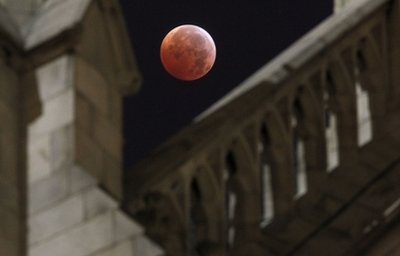
Red Moon over St. Patrick's Cathedral, NY
December 21, 2010
AP photo, Julio Cortez
Finally, to commemorate this notable day in history, we remind ourselves that Someone once caused His servant, Joel to write a fore-knowledge of these times, so that we would not be caught unawares:
"So rejoice, O sons of Zion, and be glad in the LORD your God; for He has given you the early rain for your vindication.
And He has poured down for you the rain, the early and the latter rain as before.
The threshing floors will be full of grain, and the vats will overflow with the new wine and oil.
Then I will make up to you for the years that the swarming locust has eaten, the creeping locust, the stripping locust and the gnawing locust, My great army which I sent among you.
You will have plenty to eat and be satisfied and praise the name of the LORD your God,
Who has dealt wondrously with you;
Then My people will never be put to shame.
Thus you will know that I am in the midst of Israel, and that I am the LORD your God, and there is no other;
And My people will never be put to shame.
The Promise of the Spirit
It will come about after this that I will pour out My Spirit on all mankind; and your sons and daughters will prophesy,
Your old men will dream dreams, your young men will see visions.
Even on the male and female servants I will pour out My Spirit in those days.
The Day of the LORD
I will display wonders in the sky and on the earth, blood, fire and columns of smoke.
The sun will be turned into darkness and the moon into blood before the great and awesome day of the LORD comes.
And it will come about that whoever calls on the name of the LORD will be delivered;
For on Mount Zion and in Jerusalem there will be those who escape,
As the LORD has said, even among the survivors whom the LORD calls."
Joel 2:23-32